Everything the driver needs, on a single panel.
TENTAK MMI brings together CCTV video from every compartment, cabin lighting control and passenger information on the driving cab panel, with operation fully autonomous on the vehicle's or train's local network.
One panel. The whole cab.
TENTAK MMI is NSS's cab terminal: a touch panel that brings together, in a single point of control, everything the driver needs to monitor and operate the train: live CCTV video from any compartment, cabin lighting control and passenger information (PIS).
The application runs fully autonomously on the vehicle's local network — with no dependence on an internet connection or any cloud service. The vehicle's configuration (bus compartments or rail rolling-stock carriages) is discovered automatically on every start-up, with no fixed IPs and no manual reconfiguration.
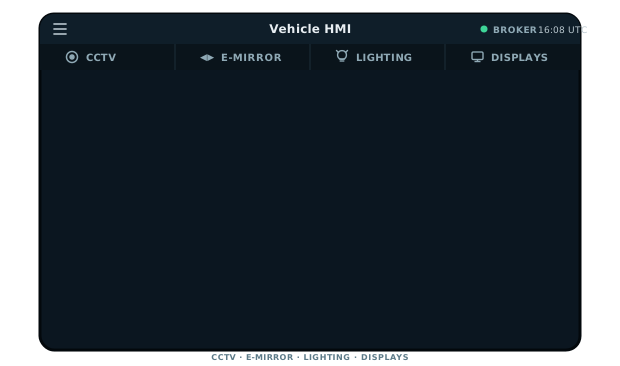
CONCEPT — proposed interface for the TENTAK MMI functions; screen not yet developed, not a screenshot of the system. Cameras and compartments are fictitious demonstration data.
Capabilities
Live CCTV
Video from any camera in any compartment, in automatic grid or floor-plan view, with a secure, encrypted connection to the onboard system.
Digital mirror (e-mirror)
Always-on video pipeline for the safety cameras that replace the physical mirror, with an immediate, visible warning in case of failure.
Alert engine
AI detection events, classified by severity and compartment, with visual indication and configurable decay of older alerts.
DALI-2 lighting control
Direct connection to the vehicle's lighting control units (LCU) over the DALI-2 bus, to adjust colour temperature, intensity and reading light without leaving the panel.
Passenger information (PIS)
View and change the route/destination on the vehicle's panels, either per individual panel or by simultaneous broadcast to the whole panel fleet.
Autonomous on the vehicle network
Automatic compartment discovery via mDNS and real-time events over MQTT, with no dependence on an external connection to operate.
Integration
Vehicle-type agnostic
The same compartment-discovery architecture — with no code changes, only network configuration — works both in bus zones/compartments and in train carriages. As a product, TENTAK MMI is designed and validated for the rail cab terminal; the bus range is served by the TCU family.
Train-formation confirmation (rail)
When an upstream service infers the train's formation, the driver confirms, corrects or rejects the inference before downstream services — doors, passenger counting, onboard information — act on that formation.
End-to-end security
Secure, encrypted connection to the onboard system, with a full auditable record of all access.
Flexible installation
Runs on its own onboard hardware or on the computing unit already present on board, depending on what is specified for the vehicle variant.
Terminal and integration validated in a real rail environment
This HMI was developed under the PRR / RRStock programme (WP5). The cab terminal and its integration with the onboard system were completed and validated in a project environment, including tests with real onboard rail hardware — an onboard video gateway and interior/exterior cameras per compartment. The screen and interface shown on this page are a concept, not yet developed.